
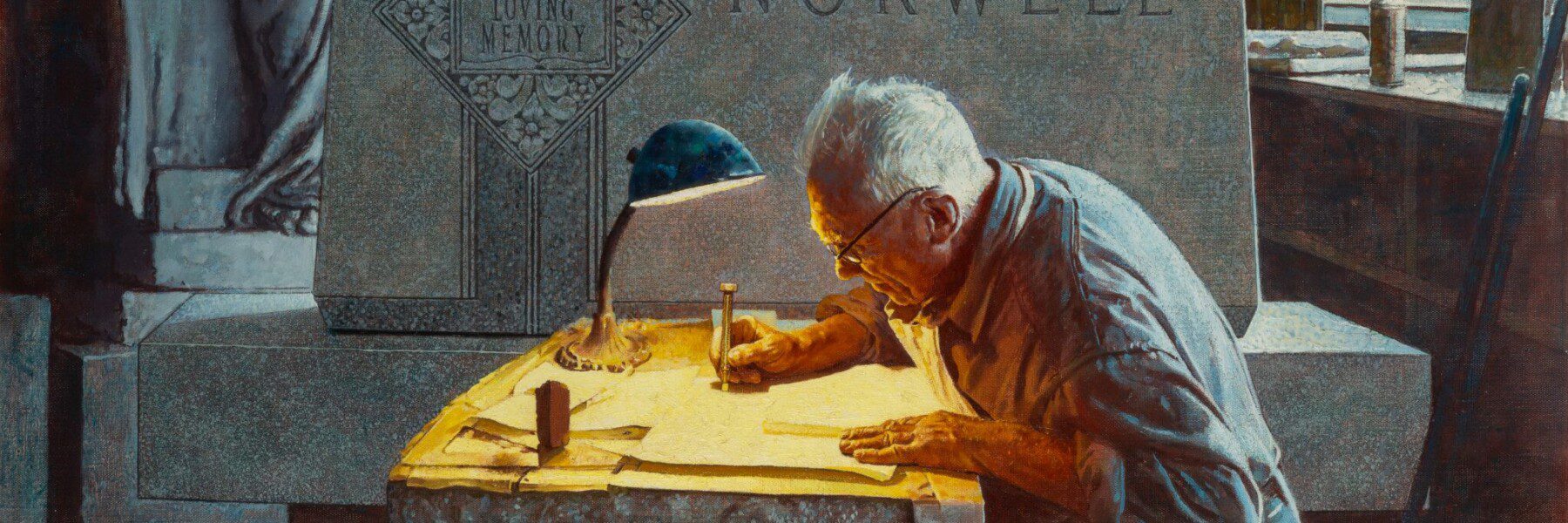
Norman Rockwell: At Home in Vermont explores how America’s beloved illustrator Norman Rockwell (1894–1978) crafted an idealized vision of Vermont—nostalgic, resilient, and mythic—during his most prolific years in Arlington (1939–1953). In his works, Rockwell offered a nation battered by the Great Depression and weathering World War II a reassuring image of American life: orderly, self-reliant, and picturesque. As Arlington-based author Dorothy Canfield Fisher (1879–1958) wrote, “Most Americans are afraid of poverty or social inferiority or change or politics…but it is true [that in Vermont] a whole stateful of people have no ground for apprehension.”
Through paintings and illustrations, Rockwell captured not simply scenes of New England life, but a deeply rooted ethos, one in which democratic community, moral clarity, and quiet individualism flourished. As noted in the “The Atlantic” in 1933, Vermonters were “all rare birds,” unwilling to conform to any easy type. Their independence of mind, combined with the state’s pastoral landscape—”red barns, old mills, lovely valleys,” as Arlington-writer Charles Edward Crane (1884–1960) admired—offered a haven for artists seeking a life apart from the anxious materialism of America’s cities.
The exhibition situates Rockwell’s Vermont years within a broader creative milieu, highlighting the Arlington artist circle that included Mead Schaeffer (1898–1980), John Atherton (1900–1952), and Gene Pelham (1909–2004), all informally enticed to Arlington, Vermont. Together, they helped define a cultural moment in which Vermont was mythologized as democracy’s granite-strong refuge. Even Rockwell’s orchestrated friendship with Anna Mary Robertson “Grandma” Moses (1860–1961) was part of a wider crafting of New England as both authentic and marketable—where artists and audiences alike found a form of moral anchorage.
Featuring the newly acquired Rockwell paintings to Shelburne Museum celebrating Vermont’s granite industry—long regarded as the state’s “backbone”—Norman Rockwell: At Home in Vermont examines not only the imagery but the careful mythmaking that made Vermont central to Rockwell’s enduring vision of America. In Arlington, far from the instability of New York—where, as a young man, he had found only transience and hardship—Rockwell discovered a community willing to stand still long enough to be documented: resilient, unpretentious, and, like the landscape itself, remarkably enduring.
Murphy Gallery, Pizzagalli Center for Art and Education